
How to track capital calls and distributions across 10+ funds
What to record from each notice, and the traps that can distort your multiple and your unfunded commitment
To track capital calls and distributions across many funds, record more than the amount of each notice. Capture the type of flow, the split between investments and fees, any recallable amount, and your unfunded commitment after the notice. Then check your running totals against each fund's capital account statement every quarter. Below five funds, a spreadsheet does the job. Above ten, small errors pile up, and you need a setup that checks itself.
Take Thomas, a private investor with commitments in 12 private equity and venture funds. Every year he receives dozens of notices from 12 different GPs, each with its own layout and vocabulary. Most are routine. A few contain a detail that changes his numbers if he takes the notice at face value.
All notices, funds and figures below are fictional, but modelled on real ones.
The fields to capture from each notice
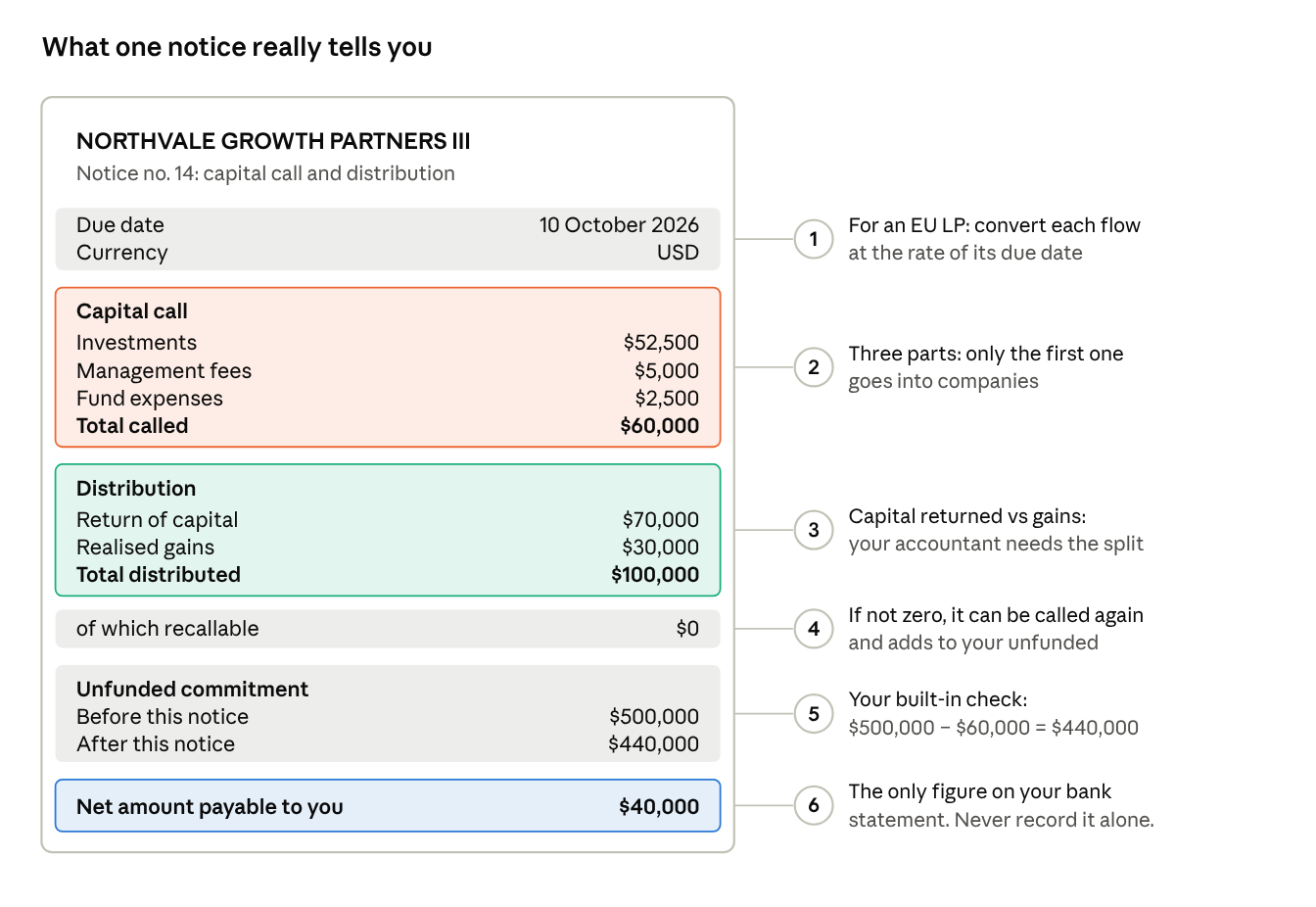
Most investors record one number per notice: the amount that leaves or reaches their bank account. That number is only part of the story. The rest of the notice matters just as much:
| Field | What it tells you | Why it matters |
|---|---|---|
| Due date | When the cash moves | Liquidity planning, matching your bank account |
| Type | Capital call, distribution, both in one notice, or a negative call | Combined notices and negative calls are easy to misread |
| Call split: investments, management fees, fund expenses | Where your money goes | Fee monitoring, true deployment |
| Distribution split: return of capital, gains, income, withholding tax | What came back, and in what form | Tax reporting, DPI |
| Recallable amount | The part of a distribution the GP may call again | Your real unfunded commitment |
| Currency | The fund's currency, and the exchange rate when money moved | Your return in your own currency |
| Unfunded commitment, before and after | What you can still be asked to pay | Liquidity planning, a built-in check |
| Net amount payable or receivable | The cash that moves | Bank reconciliation, and nothing else |
On the fictional Northvale Growth Partners III notice below, each field is highlighted.
Spreadsheet, Claude or dedicated tool
Reading a single notice is no longer the hard part. The harder part is keeping every notice over the years and catching the errors that slip in.
| Approach | Reading one notice | Keeping the history | Catching errors |
|---|---|---|---|
| Spreadsheet | You type it | Yes, if you keep it up | No |
| ChatGPT or Claude | Good, if you know what to ask | Only if you set it up and maintain it | Only the checks you ask for |
| Dedicated tool | Good | Yes | Yes, against the GP's statements |
The spreadsheet is where almost everyone starts, and for a handful of funds it is fine. The trouble is that it only knows what you type. Nothing flags a missing notice or a fee booked in the wrong column.
Pasting notices into an AI model works well on a single notice. A good model usually separates fees, spots a combined notice and refuses to invent an exchange rate. But you need to know what to ask: if you don't ask for fees or unfunded commitment, you won't get them. The model also tends to hand the hard decisions back to you, such as whether an amount is recallable, which rate applies, or whether a payment is a refund or a distribution. In a plain chat, each conversation starts from zero. AI assistants with file access can keep a history, but you design the process, collect every notice and check the results yourself.
A dedicated tool also extracts the data, then keeps every notice in one place, shows the source behind every number and checks the running totals against the GP's statements. Our comparison of LP portfolio tracking software reviews 12 options, including ours.
Traps that distort your numbers
Each of these comes from a notice that looks routine, and each changes a number you rely on: your multiple, your unfunded commitment, or both.
1. Not separating fees from investments
Thomas committed €1,000,000 to Halvorsen Capital IV. After four years, €500,000 has been called: €420,000 invested in companies and €80,000 in management fees (2% of the commitment for four years). His distributions plus the fund's current value total €600,000.
If he records the whole €500,000 as "invested", his net multiple is still correct: 600 / 500 = 1.20x. But the fees are invisible. He cannot compare fee levels across funds, check them against the fund agreement, or see that on the money invested the fund turned €420,000 into €600,000, a 1.43x gross multiple. Without the split, he cannot tell whether a weak fund suffers from poor picks or from heavy fees.
If he records only the investment part, the error flatters him. This happens when fees are called on a separate notice, or deducted from a distribution rather than called. His multiple becomes 600 / 420 = 1.43x instead of 1.20x, purely through bookkeeping.
The fix: record each component on its own line: investments, fees and expenses for a call; return of capital, gains and income for a distribution.
2. Recording a combined notice as one net amount
In our data, about one in four distribution notices also includes a capital call. Northvale Growth Partners III, a US fund, sends Thomas one notice that calls $60,000 for a new investment and distributes $100,000 from an exit. At the bottom, in bold: "Net amount payable to you: $40,000".
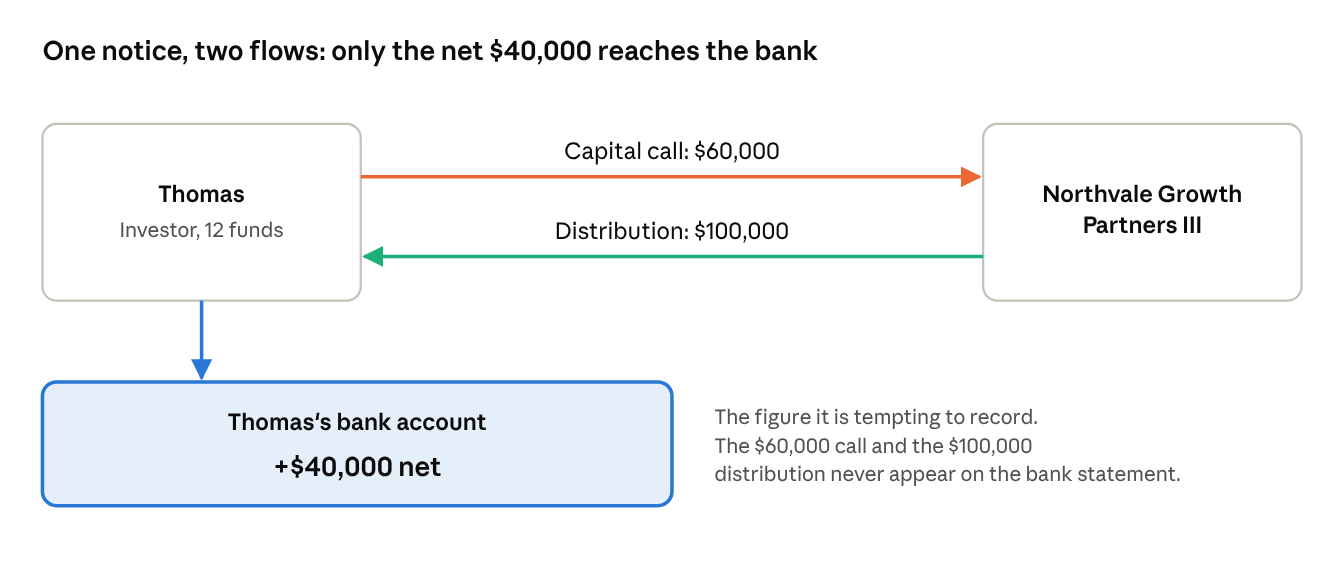
The tempting move is to record a $40,000 distribution, the only number that reaches the bank. Before this notice he had paid in $500,000, received $200,000, and the fund valued his stake at $400,000 on a $1,000,000 commitment.
| Recorded gross (correct) | Recorded net | |
|---|---|---|
| Paid in | $560,000 | $500,000 |
| Distributed | $300,000 | $240,000 |
| TVPI | 1.25x | 1.28x |
| DPI | 0.54x | 0.48x |
| Unfunded commitment | $440,000 | $500,000 |
Netting makes the multiple look slightly better, understates the cash actually returned, and suggests he still owes $60,000 more than he does.
The fix: always record the gross call and the gross distribution, even when only the net amount moves.
3. Treating a recallable distribution as final
Merrow Buyout Partners II distributes €50,000 to Thomas. In the small print: "of which €30,000 is recallable in accordance with clause 5.4 of the LPA". This is typically capital returned soon after it was invested, which the GP may call again.
If he records a €50,000 distribution and leaves his unfunded commitment unchanged, he will believe that €100,000 can still be called on his €1,000,000 commitment, with €900,000 already called. The real figure is €130,000.
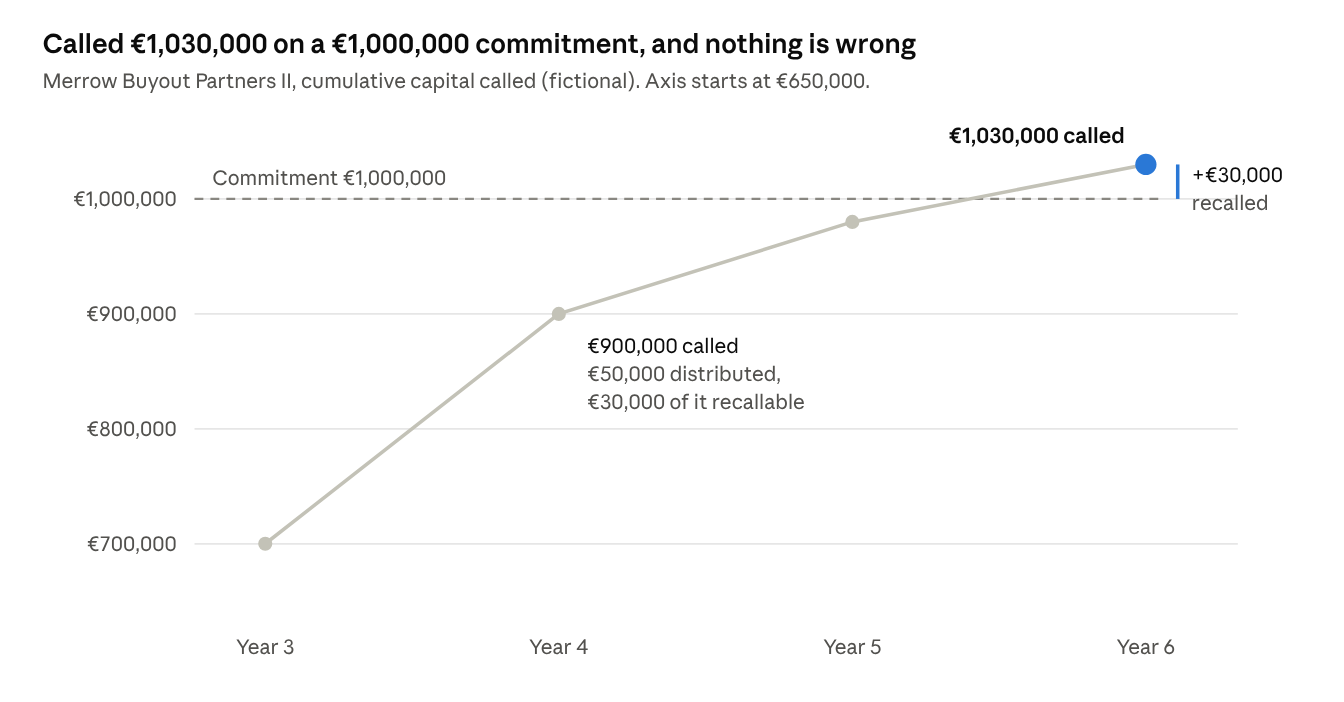
Two years later, the GP has called a further €130,000, which takes him to €1,030,000 paid in on a €1,000,000 commitment. The GP has made no mistake. Without the recallable amount in his records, the extra €30,000 was never in his liquidity plan.
The fix: read the recallable line on every distribution, and add recallable amounts back to your unfunded commitment. The exact conditions (time limits, caps) vary from fund to fund, so check the fund agreement.
4. Converting every flow at today's exchange rate
Thomas invests in euros, but Ashcombe Ventures IV is a US fund. He has paid in $500,000, at an average rate of 1.10 dollars per euro. His distributions plus the current value of his stake total $650,000, and the dollar now trades at 1.25.
In dollars, the fund has returned 1.30x, and that is the figure the GP reports. In euros, Thomas paid €454,545 and holds €520,000 of value: 1.14x. The dollar's fall cost him a large part of the gain.
If he converts everything at today's rate, his calls become €400,000 and his multiple shows 1.30x again. The currency loss disappears from his records, and the fund looks like a better investment than it was for him.
The fix: convert each call and distribution at the rate of the day the money moved, and only the current value at today's rate. That way you can separate the fund's performance from the currency effect.
5. Recording a negative call as a distribution
Ardent Seed Fund II calls €80,000 from Thomas for an acquisition. The deal falls through. A few weeks later he receives "Capital call no. 9: −€75,000, return of excess capital". The fund keeps €5,000 for costs already incurred.
Money comes back, so it is tempting to record a €75,000 distribution. In reality, it cancels most of the earlier call. Before it, he had paid in €300,000 and received €60,000 on a €500,000 commitment, and his stake is valued at €260,000.
| Recorded as negative call (correct) | Recorded as distribution | |
|---|---|---|
| Paid in | €225,000 | €300,000 |
| Distributed | €60,000 | €135,000 |
| TVPI | 1.42x | 1.32x |
| DPI | 0.27x | 0.45x |
| Unfunded commitment | €275,000 | €200,000 |
Recorded as a distribution, his DPI looks far better than it is, his total multiple looks worse, and his records show €75,000 less still to be called than the fund can actually call.
The fix: record a negative call as a reduction of what you paid in, not as a distribution. In most cases it also restores your unfunded commitment, but check the notice wording.
Reconcile with the capital account statement
Every quarter or half-year, each GP sends a capital account statement with your cumulative contributions, distributions and unfunded commitment. If your notices are complete and correctly recorded, your running totals match it. If they don't, something needs checking, and the size and direction of the gap tell you where to start.
Thomas's records for Linden Peak Ventures I show €400,000 contributed. The statement shows €430,000. A €30,000 call went to an old email address, or sits unread in the GP's portal. If he never paid it, he is heading for a late payment, which fund agreements penalise with interest and sometimes a loss of rights. And his multiple is off: with €120,000 distributed and a stake worth €450,000, he sees 1.43x in his records against 1.33x in reality.
- Add up every notice for the fund up to the statement date.
- Compare three totals with the statement: contributions, distributions, unfunded commitment.
- If your contributions are too low, look for a missing call. If both contributions and distributions are too high, look for a negative call recorded as a distribution.
- If the unfunded commitment differs, look for a recallable amount or a combined notice recorded net.
- Note the result, so the next period starts from a reconciled base.
With 12 funds this means dozens of reconciliations a year. It is also your safety net for reading errors, whether a person or an AI model read the notice. A spreadsheet will not do it for you, and a chat with no memory from one quarter to the next cannot.
A reliable setup for 10+ funds
Whatever the tool, a reliable setup:
- Splits every call into investments, fees and expenses
- Records combined notices gross, both the call and the distribution
- Tracks recallable amounts and adds them back to your unfunded commitment
- Converts each flow at its own exchange rate, not today's
- Treats negative calls as refunds, not distributions
- Reconciles with every capital account statement
With these in place, you get a consolidated view you can trust of what you have committed, paid, received and still owe across all your funds. You need that view before you can compare IRR and MIRR or forecast your future calls.
Frequently asked questions
What's the best way to track capital calls and distributions across several funds?
Record each notice with its full split: investments, fees and expenses for calls; return of capital, gains and income for distributions; plus any recallable amount and your unfunded commitment. Then reconcile your running totals with each fund's capital account statement every quarter.
Can I use ChatGPT or Claude to track capital calls and distributions?
Yes, for reading notices, and with file access they can maintain a spreadsheet over time. But you design the process, collect every notice, and check that each one is treated the same way quarter after quarter. A dedicated tool does the collecting, the consistency and the reconciliation for you.
What is a recallable distribution?
It's a distribution the GP may call again later, usually capital returned soon after it was invested. Until the recall period ends, add it back to your unfunded commitment, or you'll underestimate what you can still be asked to pay.
What is a negative capital call?
It's a refund of capital already called, for example when a deal falls through. Record it as a reduction of what you paid in, not as a distribution, or your DPI will look better than it is.
How do I track funds in a different currency?
Convert each call and distribution at the exchange rate on the day the money moved, and only the current value at today's rate. Converting everything at today's rate hides the currency effect on your return.
Why reconcile with the capital account statement?
It's the GP's running total of your contributions, distributions and unfunded commitment. If your records don't match it, something is missing or recorded differently.
Track your notices with Clariteer
Clariteer is in limited early access for individual investors and family offices. Tell us a few words about your portfolio and we'll get back to you.



We regularly write about private equity
Be notified when a new article is published.
No spam, no sequences. Unsubscribe anytime.